.svg)
.svg)
.svg)
.svg)
.svg)
.svg)
.svg)


A TRUSTED PRENUP THAT’S AFFORDABLE
We value full
financial transparency
.svg)
.svg)
.svg)
.svg)
.svg)

.avif)
.avif)


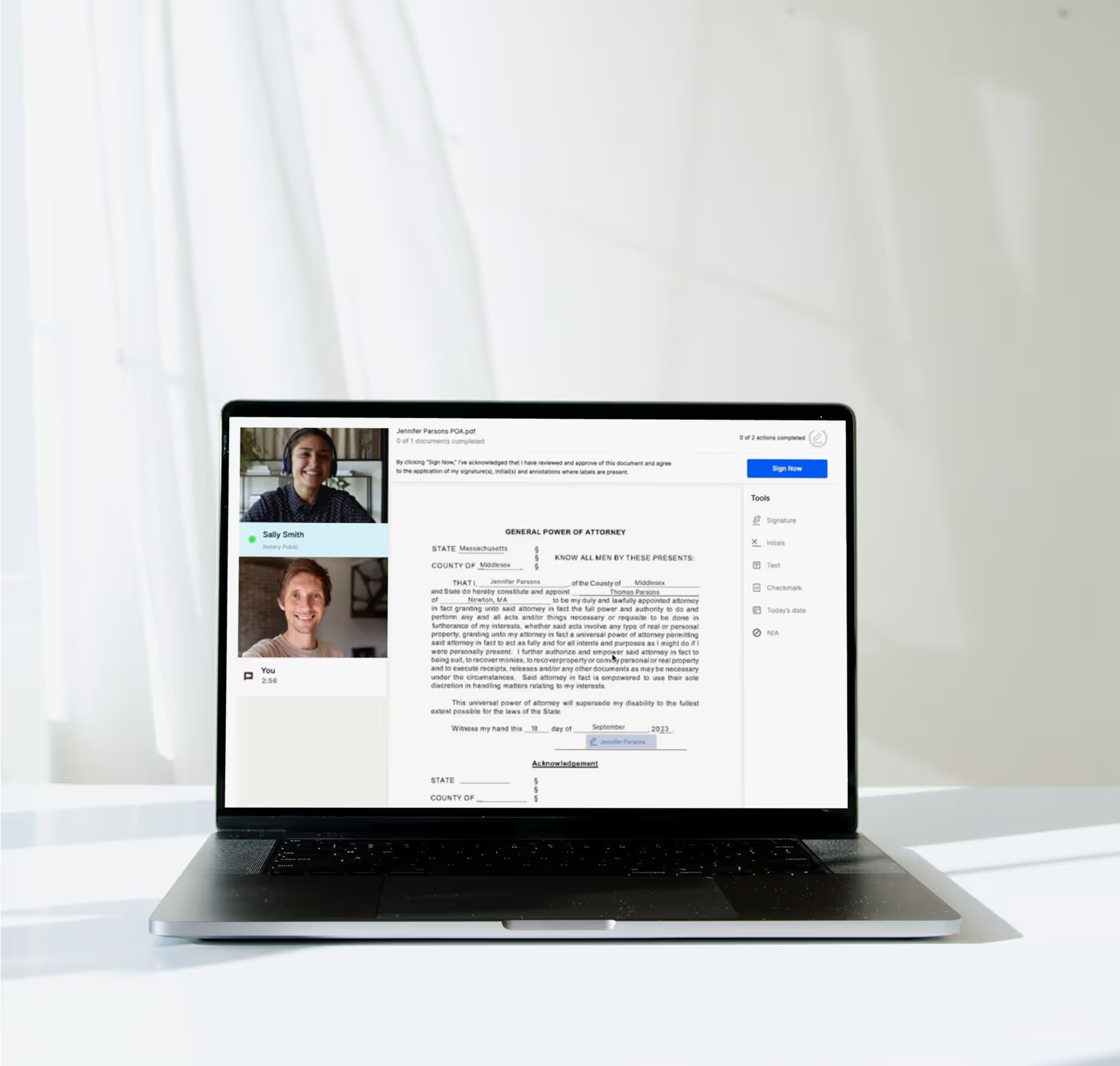
A Prenuptial Agreement (more formally called a Premarital Agreement in Cali) is a legal contract that is drafted between two parties prior to getting married, and in California, like most states, is effective upon marriage.
California’s Uniform Premarital Agreement Act (UPAA) is the law of the land in California as pertains to prenups, and outlines the rules and requirements for a valid agreement. The terms of a prenup agreement may outline the rights to property acquired prior to, during, or after marriage – including but not limited to, assets, debt, inheritance, gifts, real estate, income and earnings, as well as future interests. A prenup agreement will also specify what will happen to this property while married, in the event of separation or divorce.
Your Premarital Agreement can also contract to the rights of spousal support, including the waiver of support, but cannot contract to child support nor custody. If you intend on waiving or specifying how spousal support may be paid in the future, make sure to read the details below. California’s UPAA outlines rules on how this must be done. What is the UPAA and how does it apply to prenups? Here’s an explanation.
California prenup requirements

As of January 1, 2020, California’s Family Code section 1615(c)(2)(B), states that there must be at least 7 days in between presentation of the final agreement and when the parties sign it.
Why does this matter? To provide parties enough time to obtain legal representation if they want it—or, to make sure both parties have considered the impact of the terms.
Complete is imperative in California prenuptial agreements.
Both fiances must disclose all of their income, assets and debt.
This is done via a a “financial schedule,” which is a snapshot of all of your income, assets, debt and future inheritance and attached to the end of your prenuptial agreement.
A Waiver of Further Disclosure is required in California to confirm that you and your fiancé understand and agree that you have each received sufficient supporting documentation for all of your financial disclosure details, and that you are comfortable with the level of disclosure received. Not to worry… this is included in your HelloPrenup agreement!
Spousal Support and Alimony in California

California offers a few different types of spousal support: temporary support, rehabilitative support, and permanent spousal support.
For the fine print on California Spousal Support, review Cal Fam Code§4330
Under the California UPAA (the California Prenuptial Agreement statute), if you or your future spouse plan to waive your rights to Spousal Support, or agree to terms relating to Spousal Support that differ from California law, it is imperative that the waiving party be represented by an attorney at the time the agreement is signed.
If that party is not represented by a lawyer, the agreement is at risk of future enforcement and the Spousal Support waiver will not be enforced.
Now, California is pretty clear on this point, which is why we want to highlight it for you. In most states, there is a higher likelihood that any waiver of Spousal Support will be set aside, and whether or not this is the case will heavily depend on the financial circumstances of the parties at the time of divorce and whether or not one party will be left destitute.
“If I need a lawyer for a valid spousal support provision, how can I use HelloPrenup?”
Many engaged California love birds choose to use the HelloPrenup platform to negotiate and draft their prenup, and then choose to seek legal counsel prior to signing. HelloPrenup now offers attorney services directly in your account.
If you waive or modify spousal support using HelloPrenup, we’ll connect you with vetted attorneys to suffice the signature needed. If you plan on waiving or modifying spousal support, plan on hiring attorneys for signatures. HelloPrenup offers discounted, exclusive rates for these services at $699 per partner.
The requirement of “access to independent counsel” represents the view that representation by independent counsel is crucial for a Party waiving a right as important and life altering as Spousal Support in a California prenuptial agreement. The California Family Code does require representation for an agreement to be enforceable. See California Family Code § 1612(c) linked below for the full text.
See subsection (c) of the California Family Code relating to this provision:
“(c) Any provision in a premarital agreement regarding spousal support, including, but not limited to, a waiver of it, is not enforceable if the party against whom enforcement of the spousal support provision is sought was not represented by independent counsel at the time the agreement containing the provision was signed, or if the provision regarding spousal support is unconscionable at the time of enforcement. An otherwise unenforceable provision in a premarital agreement regarding spousal support may not become enforceable solely because the party against whom enforcement is sought was represented by independent counsel.”

.avif)
.avif)
Important cases relating to CA Spousal Support
In January of 2013, the California Court of Appeals ruled on the case In re Marriage of Facter, 212 Cal. App. 4th 967, that the spousal support waiver that was present in the Facters’ prenuptial agreement was unenforceable because it is unconscionable. This holding set a precedent for California courts moving forward. In the Facter case, at the time the Premarital Agreement was signed, the wife was an unemployed high school graduate and single mother of two children. Meanwhile, the husband was an accomplished Harvard educated attorney who earned about $500,000 per year at the time of the prenuptial agreement. To get a better handle of the scope of this prenuptial agreement, here are some of the provisions it included.
When the prenup was challenged in court by the wife, the California court held that the waiver of spousal support was unconscionable because of the dramatic disparity in the husband and wife’s “respective incomes and assets at the time they entered into the Agreement,” and the court further reasoned that there existed “a significant inequality of bargaining power.” The court reasoned that the husband and wife’s financial situations if the contract was enforced would also make the spousal support waiver “unjust.” The court detailed their reasoning, citing that the husband had amassed approximately ten million dollars in assets and earned one million dollars per year at the time of divorce, while the wife remained unemployed and had no separate assets of her own during the marriage.
This case is JUICY. (We’ll skip the salacious details but you can check out the full read here!) Aside from the real housewives level drama, this case clarified a really important point of law for California prenups. Since 2002, California courts have been invalidating spousal support provisions which are considered to be unconscionable at the time the parties seek enforcement (i.e. upon separation/divorce). While we know this is the case for prenups entered into after that time, what about prenups predating 2002? Well, the Zucker case is here to clear things up!
Mr. and Mrs. Zucker got hitched in 1994. While the couple was dating, Mrs. Zucker became pregnant and wanted to get married. Mr. Zucker was slightly hesitant. He had acquired decent wealth and would only agree to marry if his future wife would sign a prenup. She agreed and the couple wed. The prenup limited Mrs. Zucker’s spousal support to $6,000 per month with a one-time payout of $10,000. Mr. Zucker would also get to keep the couple’s home in the event of divorce.
After 17 years of marriage and six children, the couple called it quits. At this point, Mr. Zucker had a net worth of approximately $32 million. In contrast, Mrs. Zucker was unemployed, having opted to stay home and raise the couple’s children during their marriage. Mrs. Zucker challenged the validity of the couple’s premarital agreement arguing that it was unconscionable considering the current disparity in the couple’s finances. Mr. Zucker, however, argued that all that mattered was whether it was conscionable at the time the couple entered into the agreement (before he accumulated the bulk of his wealth).
The court ultimately agreed with Mrs. Zucker. It was discovered during the court proceedings that in order for Mrs. Zucker to maintain a similar lifestyle to that which was established during her 17-year marriage, she would need around $37,000 per month. The $6,000 monthly support provided by the premarital agreement was considered unconscionable at the time of the couple’s divorce. Specifically (and importantly!), it was considered to be contrary to public policy. As a result, the spousal support provision was invalidated.
Moral of the story: Now all prenups entered into after 1986 can be invalidated by California courts if they contain provisions limiting spousal support which are considered to be unconscionable at the time of enforcement.
The Barry Bonds case is a California Prenuptial Agreement case that was decided in 2000 by the California Supreme Court. The Bonds case is considered one of the most famous prenup cases in California because it forever changed how prenups in the state would be drafted. Barry Bonds, the San Francisco Giants baseball player and his then-wife Sun married in 1988. Before the couple married, Bonds asked Sun to sign a prenuptial agreement, stating that Sun would waive the right to any of Bonds’ income, earnings, or acquisitions during their marriage. At the time, Bonds was earning a significant sum.
Bonds hired an attorney to draft the prenuptial agreement, and Sun signed the agreement without consulting or hiring an attorney. Fast forward six years and two children later, and the couple filed for divorce. At the time of divorce, Bonds’ salary had increased significantly. On the other hand, Sun did not work during the marriage. Prior to the marriage, she had worked as a waitress and bartender, and had at some training in cosmetology. However, none of these jobs were likely to earn her income approximating that of her husband, a famous baseball player. Even though Sun had been unemployed at the time she signed the premarital agreement, she had voluntarily waived any interest in her husband’s earnings over the course of the marriage.
As expected, Sun fought to have the California prenup declared unenforceable and to have alimony instituted. Her attorneys argued that the provisions of the agreement could not be enforced because she had no lawyer at the time she signed the agreement. The Superior Court upheld the prenuptial agreement, and Sun appealed. The decision of the lower Court was reversed. After an appeal by Bonds to the Supreme Court of California, the case was decided in favor of Bonds and the Prenuptial Agreement was enforced. The Court concluded that the agreement was valid and was voluntarily entered into by both parties prior to their marriage, and thus should be enforced. This decision lead to wide media coverage and an outcry of public opinion in favor of Sun.
Life before Bonds…
Before the Bonds case, California courts recognized prenuptial agreements if they were signed by both spouses, even parties that were not represented by their own attorneys. The Bonds case received notable press, and the public sided very clearly with Sun. Since the Bonds case that inspired change in California law, prenuptial agreement requirements in California are now much more clear. The case spurred a change in legislation in California, and the California Family Code Section 1615 was born.
Embryo Clauses in California
1 in 6 couples experience infertility.
With more families turning to IVF, it’s becoming increasingly common to have embryos now—or plan for them later.
Not sure if you’ll have embryos?
Infertility is like “the d-word”: no one expects it, but nearly 42% of adults pursue fertility treatments. Preparing early protects you both.
Why add Embryo Clauses to your prenup?
What can you cover?
HelloPrenup’s Embryo Clauses address everything from custody of embryos in a divorce to responsibility for storage fees. You can even outline legal parenthood in the event of death or separation.
Ending a marriage in California
Although you may never need to use this information, we think it is important to understand.
The 3 ways that a couple can legally end a marriage is through divorce, legal separation, and annulment. Only one party needs to begin the process of ending a marriage (but don’t get us wrong, it takes two to make it work!) If one party wants to divorce the other party, it is within their sole right to do so and the other non-participating party does not have to agree in order to begin the process. If a non-participating spouse does not partake in the proceedings, a default judgment will be entered and force the divorce to proceed.
Specifics about Divorce in California: The following excerpt is taken from the CA Family Code, s.2010: In a proceeding for dissolution of marriage…or for legal separation of the parties, the court has jurisdiction to inquire into and render any judgment … concerning the following:
Residency requirements: Each state has residency requirements that must be fulfilled before you can divorce in that state. In California, these are the residency requirements:
“Dissolution of marriage” is the term used in California to refer to a divorce.
A dissolution of marriage occurs when two people, who have been legally married, begin the court process to have the marriage ended.
In some states, the term “dissolution of marriage” refers to the general process of a divorce. In other states, the term “dissolution” is used in reference to a “no-fault” divorce, whereas the term “divorce” refers to a “fault” divorce.
It's important you understand that certain legal terms can refer to certain processes that differ greatly per state. In California, the term “dissolution of marriage” is often used in place of the more commonly used term “divorce.”
By default, California is a “no fault” divorce state – meaning, either party can file for a divorce without having to prove that the other party did something “wrong” to justify the dissolution of the marriage (these are called “fault grounds.”)
Unlike some states, California does not have a minimum legal separation period required before filing for a dissolution of marriage.
To proceed with a no fault divorce, only one party of the marriage needs to state that the marriage is not working out, and thus claiming “irreconcilable differences.”
For the entire fine print review Cal Fam Code §2024
.avif)
.avif)
.avif)
.avif)
.svg)
.avif)
.avif)

.avif)
.avif)
.svg)
.svg)
.svg)
Same-day completion. Taxes included.
Start your prenup for free.svg)





.svg)
.svg)
.svg)
.svg)
.svg)
.svg)