The leading, comprehensive
South Dakota prenup
Welcome to South Dakota, where it’s all about wide open spaces and South Dakota love & romance (yes, we’re making that a thing). And when it comes to protecting your future, a little prep work never hurts. Think of it as your love’s insurance policy, just in case “happily ever after” takes an unexpected detour.
Forbes LogoShark Tank LogoThe New Yorker Logo
Person typing on a laptop displaying a questionnaire webpage with a prenup checklist.
“Like Turbotax for prenups.”
(real quote from one of our customers!)
We’ll walk you through all of the scenarios you’ll need to consider in South Dakota
Couple standing close together on a paved lookout, gazing at a scenic view of trees and distant mountains under a clear sky.
Only $599 for an official, South Dakota-specific prenup
Excellent 4.8
Trustpilot
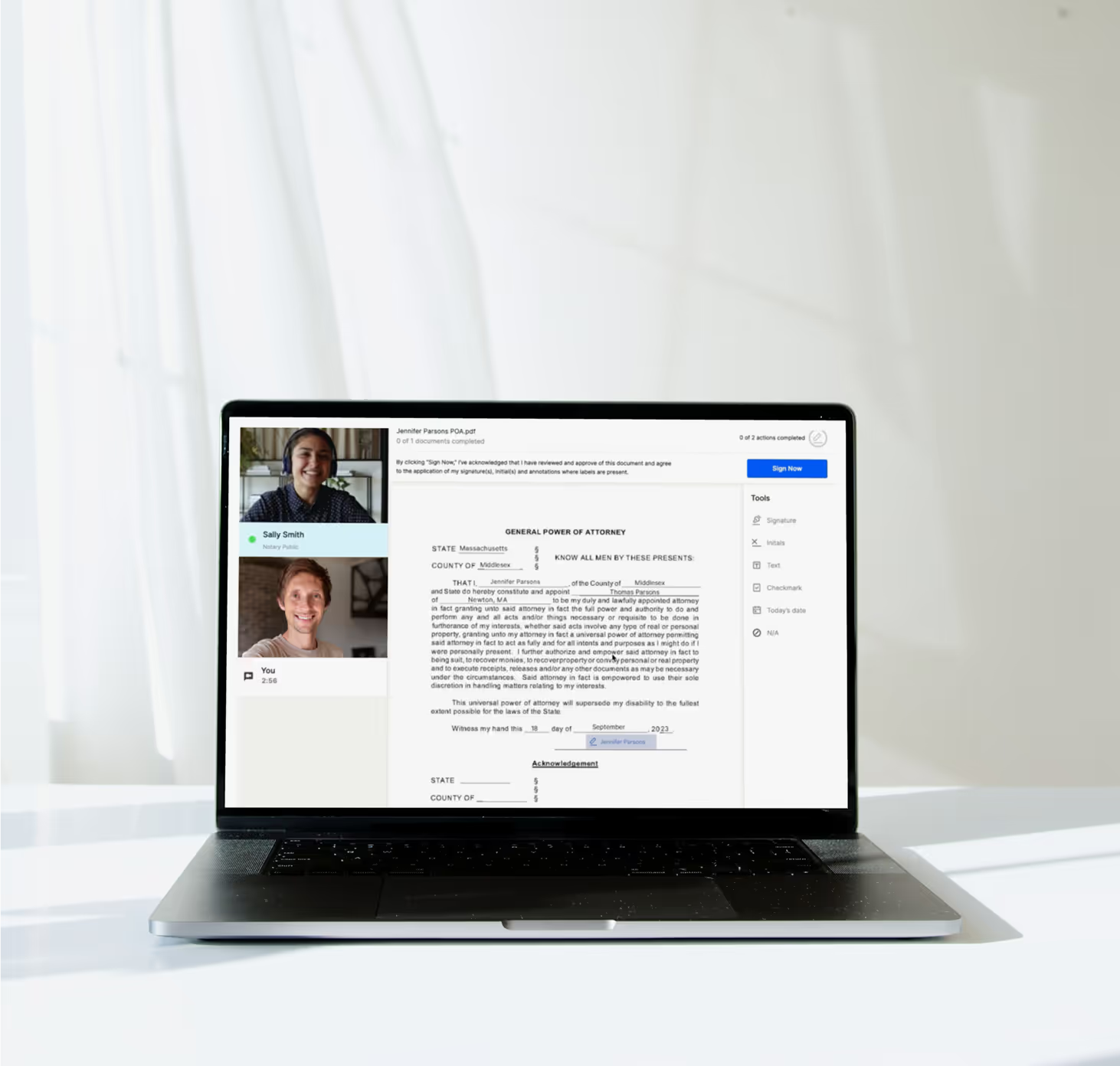
Open laptop on white desk displaying a video call with two people and a document titled 'General Power of Attorney' open on screen.
Real South Dakota attorney support and services in-app
Affordably access support from South Dakota-based attorneys any time — all online.
WE’RE THE WORLD’S PRENUP EXPERTS
Everything to know about South Dakota prenups
In South Dakota, a prenuptial agreement (also known as an antenuptial or premarital agreement) is a contract created by two people before they get married. South Dakota’s Uniform Premarital Agreement Act (Sections 25-2-16 to 25-2-25) outlines specific rules for how these agreements should be made and enforced. One crucial thing to keep in mind is that prenups only become effective on the official wedding day and don’t require additional “consideration” (something of value exchanged) to be valid.
The do’s and don’ts of a South Dakota prenup
What makes a South Dakotan prenup valid and enforceable, you ask? Look no further than the South Dakota Uniform Premarital Agreement Act. Much of the law comes from this Act and also case law that further defines and explains it as applied to real prenups.
Requirements
Green checkmark icon indicating confirmation or success.
The prenup must be in writing.
Green checkmark icon indicating confirmation or success.
The prenup must be signed by both parties.
Green checkmark icon indicating confirmation or success.
The prenup must be entered into voluntarily.
Green checkmark icon indicating confirmation or success.
Both parties must provide full financial disclosure of all assets, income, and debts.
Green checkmark icon indicating confirmation or success.
The agreement must not be unconscionable.
Green checkmark icon indicating confirmation or success.
The agreement must not include terms against public policy or against the law.
Cannot include:
A black cross or X mark icon on a light background.
Terms involving child support.
A black cross or X mark icon on a light background.
Terms involving alimony.
A black cross or X mark icon on a light background.
Terms against the law or against public policy.
A black cross or X mark icon on a light background.
Signing the agreement under some form of duress (i.e., not signing it voluntarily).
A black cross or X mark icon on a light background.
Not providing proper financial disclosure (i.e., omitting important financial information).
A black cross or X mark icon on a light background.
Not permitted: Terms about child support or alimony.

Who might benefit from a premarital agreement?

We’ve got news for you: prenuptial agreements are not just for the wealthy. Anyone who wants to secure their financial future in case of divorce or death can benefit from a prenup. There’s no set requirement for how much “money you need” to get a prenup. Even if you have zero dollars, you may benefit from a prenup.

For instance, here are some examples of people who might benefit from a prenup:
  • A couple where one partner has children from a previous marriage may want to ensure their assets are passed down to their children.
  • Couples with significant assets, such as businesses or property, might want to protect those assets in the event of a split.
  • Prenups also offer peace of mind by establishing clear expectations regarding the division of assets and debts in case of divorce.
  • Prenups can also protect family inheritances
  • Prenups can ensure the financial well-being of children from previous relationships.
  • For couples with substantial assets, a prenup can help maintain those assets separately, avoiding potential conflicts and complications in the future.
By discussing financial matters openly before marriage, couples can build a foundation of trust and transparency, setting the stage for a more secure and harmonious union.
Nighttime cityscape with illuminated buildings and houses under a clear blue sky.Cityscape of Rapid City, South Dakota, at dusk with illuminated buildings and residential areas.Panoramic night view of a city with illuminated buildings, streets, and houses under a clear blue sky.

Default laws on property division in South Dakota

Without a prenup, property in a South Dakota divorce is divided under the principles of equitable distribution. This means a court will divide a couple’s assets based on principles of equity, not necessarily splitting it 50/50. In plain English? A court will look at the entirety of the situation and make a decision that is just and equitable. (S.D. Codified Laws § 25-4-44). This means property could be split 50/50, 60/40, 70/30, 80/20, or whatever the judges deem appropriate.

In addition, South Dakota is known as an “all property” state meaning that all property, whether accumulated before or during marriage is on the table for division. None of your property is automatically safe in a divorce (unless you have a prenup, of course). (See Kolbach v. Kolbach, 877 N.W.2d 822, 827 (2016) for more details on property division in South Dakota).

Default laws on alimony in South Dakota

South Dakota uses the term alimony to refer to payments made by one spouse to another in the event of a divorce (the wealthier spouse is usually the one who pays the person with less money). In South Dakota, you cannot contract around spousal support in your prenup. It is up to the court to determine who is eligible to receive alimony and for the length of time one may receive it. In South Dakota, judges have broad discretion to determine if alimony is justified on a case-by-case basis. (S.D. Codified Laws § 25-4-41).

South Dakota Courts rely on the following factors to determine the amount and length of alimony payments:
  • The length of marriage
  • The respective earning capacities of parties
  • The respective financial condition after property division
  • The respective ages, health and physical condition of each spouse
  • The station in life or social standing of each spouse, and
  • The relative fault of parties in termination of marriage.
(See Guindon v. Guindon, 256 N.W.2d 894 (S.D. 1977) for more details on how South Dakota courts award alimony).

South Dakota’s prohibition on alimony clauses in prenups

South Dakota takes a firm stance on protecting alimony, unlike most states. (Alimony=payment from one ex-spouse to the other in the event of a divorce). In South Dakota, you cannot include terms modifying alimony in your prenup. That includes waiving or modifying spousal support. Not only does Section 18 of South Dakota’s Premarital Agreement Act explicitly omit the line permitting spousal support, but South Dakota case law also explicitly bans spousal support modifications in prenups. (See Sanford v. Sanford, 694 NW 2d 283 (2005)).

This unique rule generally stems from concerns about the potential financial harm inflicted on lower-earning or financially dependent spouses if such waivers or modifications were allowed.

For instance, a couple might choose to waive alimony while both are employed. However, if circumstances change drastically – perhaps due to disability or the decision to become a stay-at-home parent – the financially dependent spouse could be left without crucial support. This could lead to severe financial hardship and even reliance on public assistance, a situation the state aims to prevent.

Do I need a lawyer in South Dakota for my prenup?

While South Dakota statutes don’t specifically require having an attorney for a prenuptial agreement to be valid, court decisions have shown that having or not having legal representation is a factor considered in determining a prenup’s enforceability. However, the absence of a lawyer during the creation of a prenuptial agreement doesn’t automatically render it unenforceable–it’s an analysis done by the court on a case-by-case basis.

How to end a marriage in South Dakota

You can file for divorce if you or your spouse are a resident of South Dakota at the time the divorce is filed. In other words, you don’t have to live in South Dakota for any set amount of time before filing, unlike other states. (S.D. Codified Laws § 25-4-30). However, there is a minimum of a 60-day waiting period before a divorce case can be heard by a court from the date the defendant was served with divorce papers. (S.D. Codified Laws § 25-4-34).

South Dakota has both “no-fault” and “at-fault” divorce. This means you can either file for a divorce under the grounds that one spouse did something wrong (fault) or that neither spouse did anything wrong (no-fault). Some different grounds for fault divorce in South Dakota include adultery and extreme cruelty. No-fault divorce is much more common because it is typically faster and cheaper than trying to prove fault in court. (S.D. Codified Laws § 25-4-2).

Important South Dakota case law

Case law, in the context of evaluating a prenuptial agreement, refers to previous court decisions that have interpreted and applied the laws governing prenups. These decisions serve as precedents and provide guidance for judges when they’re faced with similar legal issues in new cases. Let’s dive into some important case law in South Dakota pertaining to prenups!
Chevron
The landmark prenup case in South Dakota

Back in the 1970s, the South Dakota Supreme Court heard a case where a couple was fighting over the enforceability of their prenup. Mr. and Mrs. Connolly signed a prenup five days before getting married and the prenup stated (in part) that each party waived their right to claim alimony.

The couple eventually divorced. Mrs. Connolly argued that the portion of the agreement that waived her right to alimony was unenforceable because it “violated public policy” in South Dakota.

The court ultimately ruled the prenup invalid. Back then (the 70s), there was a strong societal expectation that husbands financially support wives. As a result, the prenup couldn’t be enforced, and the case was sent back to be reconsidered.

Even though this case is old, it’s still important because it sets the precedent in South Dakota: prenups can’t waive or change spousal support rights.

Connolly v. Connolly, 270 NW 2d 44 (1978)

Chevron
Can you waive your rights to your spouse’s estate after they die in a prenup?

(Spoiler alert: You can, but make sure you do it right). In a real South Dakota case involving a prenuptial agreement where a wife waived her rights to her husband’s estate upon his death, the court ruled in favor of the wife, declaring the agreement invalid. The court determined that the wife had not entered into the agreement voluntarily due to several factors:

– A significant power imbalance between the wealthy husband and the wife with limited education,

– The surprising nature of the presentation of the agreement (he drove her to his attorney’s office without telling her),

– The wife’s credible testimony of not understanding the agreement, the lack of prior discussion about the prenup, and

– The absence of independent legal counsel for the wife.

Despite this ruling, it’s important to note that waiving rights to a spouse’s estate in a prenuptial agreement is permitted under S.D. Codified Laws § 29A-2-213, as long as both parties enter into it voluntarily and it’s not unconscionable. This case serves as a reminder of the importance of ensuring that prenuptial agreements are entered into with full understanding and without undue pressure.

Connolly v. Connolly, 270 NW 2d 44 (1978)

Chevron
Can you include terms about spousal support in your South Dakota prenup? (Hint: The answer is no)

Mr. and Mrs. Sanford planned to wed. He had a net worth of 55 million, and she had a net worth of about $127,000. The prenup had provisions regarding both property division and alimony in the event of a divorce. The alimony clause stated that Mr. Sanford would pay Mrs. Sanford $144,000 in 36 monthly installments of $4,000 each, starting the month after their marriage ends.

During the divorce proceedings, Mrs. Sanford argued the prenup was unenforceable based on the spousal support provision. (Why, you ask? Well, under default law, she would have been entitled to more).

The result? The court agreed with Mrs. Sanford and ruled that South Dakota prenups may not waive alimony as per S.D. Codified Laws § 25-2-18. Therefore, the portion regarding spousal support was not valid, but the division of property was enforceable.

Sanford v. Sanford, 694 NW 2d 283 (2005)

Laptop on wooden cabinet displaying a questionnaire completion webpage with checklist items and a beach photo.Laptop on a wooden cabinet displaying a questionnaire webpage with a beach image and checklist.
HOW OUR PRENUP WORKS
Easy, all-in-one solution, completed in a day
1
Fill out your questionnaires
Share your goals and assets in your personal questionnaires.
2
Align on clauses together
Compare answers and align on your prenup terms together.
3
Optional — Review with an attorney
Meet with an attorney to further customize your prenup.
4
Review and notarize your prenup
Review and notarize your prenup online with Proof.
Certified Top Attorneys Standing By
Optional attorney support
at a fraction of the cost
Open laptop on a round wooden table displaying a webpage with profile pictures and names under 'Attorney Representation'.
Ask an attorney any time
(real quote from one of our customers!)
Get legal advice any time by adding on a 20-minute call with an attorney to your prenup for only $49 per partner, per session.
How it works
Smiling woman in orange sweater waving while video chatting on laptop in bright living room.
Optional representation
Attorneys are standing by. Select one of your state’s top attorneys to get an optional full document review for added peace of mind.
Pricing
Person using a laptop displaying a video call interface with a participant named John and a join meeting button.
Online notarization
Skip the drive to the notary. E-sign & notarize your agreement in minutes in your account through our integrated partnership with Proof.
Attorney services
Smiling couple sitting on a brown leather couch, using a laptop together in a cozy living room.Smiling couple sitting on a brown leather couch using a laptop together in a bright living room.Smiling couple sitting on a couch looking at a laptop together.
Want some guidance?
Book a free consultation
Not sure if you want/need an attorney? Book a consultation with a HelloPrenup team member today!
Learn more about how HelloPrenup works and what to expect about the process. We’re thrilled to answer any questions you have and help you get started.
A TRUSTED PRENUP THAT’S AFFORDABLE
We value full 
financial transparency
We encourage every couple to enter their marriage with full financial transparency and we’re starting our relationship with you the same way. Our prenup packages are flexible to adapt to exactly what you and your partner need.

It’s free to start creating and then requires a flat payment of $599 to complete. Along the way, you can add on additional services as needed, any time. Use the calculator to get an estimate. You can also choose to sign now and pay later with:
stat-flag-img arrow

Our online prenup $599 flat fee per couple

Notarization optional add-on
Attorney Q&A optional add-on
Attorney Representation optional add-on
Our attorney representation costs are 40–80% less than other online services i
Your customized total per couple $599

Same-day completion. Taxes included.

Start your prenup for free
A prenup isn’t just about protection.
It’s about going into marriage with a foundation based on transparency and trust.
A prenup is no longer a taboo — it’s a to-do.
Get a state-specific notarized prenup onlinewithout overspending on money or time.
Get a state-specific notarized prenup online and save on money and time.