.svg)
.svg)
.svg)
.svg)
.svg)
.svg)
.svg)
You can use a prenup as a sort of financial planning tool, allowing you and your future spouse to discuss how assets and debt will be managed during the marriage, too. The terms of a prenup can determine assets, debt, alimony (a.k.a., spousal support), inheritances, gifts, taxes, joint bank accounts, pet custody, and much more.
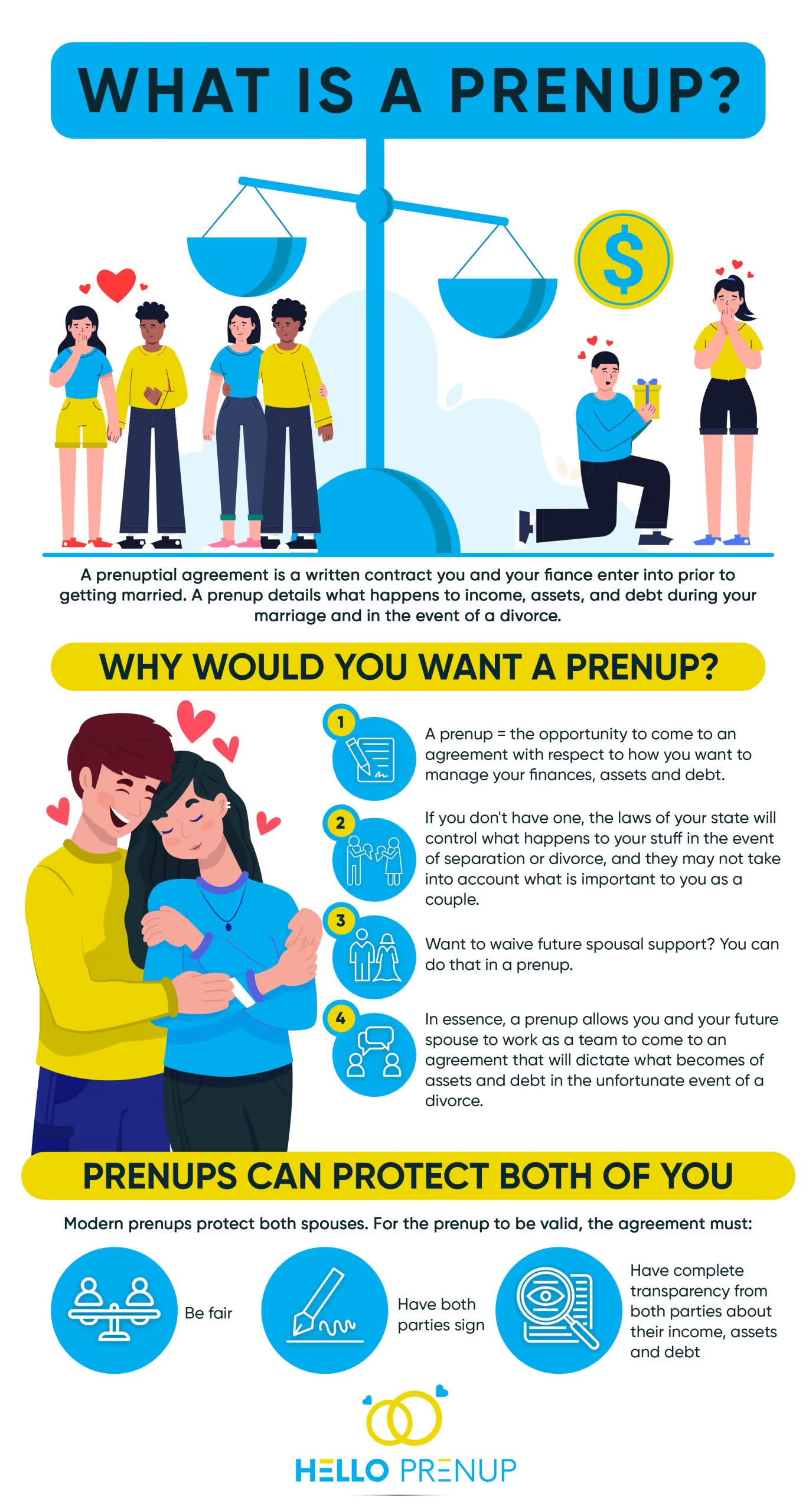
Today, couples enter into prenups to override the default divorce laws that govern marital property division and spousal support. Each state has its own divorce laws, and these default rules govern the way courts will divide property in the event of a divorce, including bank accounts, investments, and more.

Real Life
Examples

Kelly and Josh are in their mid 30’s, and are engaged to be married. Kelly purchased a condo a year before she met Josh, and since she and Josh have been dating, he moved in and now pays her rent. They also share the other expenses associated, like utilities, etc. Kelly wants to make sure that even after they are married, her condo remains her property alone. Afterall, she purchased it with her own money. Kelly wants to protect both her initial investment (the downpayment), as well as any appreciation in value on the condo during their marriage, even while Josh is living there or if the condo is their primary marital residence. After all, this condo was her investment which she worked hard for and materialized on her own! In their prenup, Kelly can list the condo as her separate property, and specify that the condo, including any appreciation on the property during their marriage, should remain hers and hers alone. If the condo is sold in the future, the proceeds will be Kelly’s separate property. If the proceeds from the sale get rolled into a joint marital home that Kelly and Josh buy together, the prenup can specify that the funds from the sale of her condo should remain her separate property, and not become marital (or community) property. Why does this matter? Depending on what state the couple lives in and the length of marriage, the condo that Kelly bought could become marital property and subject to division in a divorce. A prenup allows the couple to prevent this from happening by agreeing that an asset, like Kelly’s condo, along with any appreciation and the associated mortgage, remain Kelly’s separate property as well as separate debt.
Plot twist! Kelly has $200,000 in student debt from her undergraduate and graduate degrees. She plans to enroll in a PHD program at some point in the next couple of years, and will likely need to take out more student loans. Josh, on the other hand, has no student debt. Kelly and Josh can specify in their prenup that any debt, including Kelly’s premarital student debt as well as any school debt she accrues in the future, should remain her debt alone and not be considered joint marital debt at any time. Why does this matter? In a divorce, judges in many states have immense discretion as to how debt should be distributed among the parties. In certain situations, a judge could choose to attribute some of one spouse’s debt to the other, especially in the case where the other party directly benefited from the result of that debt.
Kelly’s parents regularly give her monetary gifts, and they plan to continue doing so after Kelly and Josh are married. Josh is pumped because he is really sick of working and these monetary gifts mean he could cut back on work, vacation more, or even pursue his hobby of becoming a surf instructor. Kelly thinks those monetary gifts should be considered her separate property and invested in her separate investment account. She does not believe those gifts should be considered marital or community property, because they come from her parents. By having a prenup, Kelly and Josh will have the right to decide together exactly how monetary gifts should be classified in their marriage, and are free to choose whether those monetary gifts should remain Kelly’s separate property or become marital or community property that is shared by the couple. Why does this matter? Without a prenuptial agreement, in most states, monetary gifts received during marriage will be considered marital, or community property. A prenup allows couples to decide if they would like those monetary gifts to be considered separate property.
Kelly’s parents plan to pass down a significant inheritance to her in the future. While they are excited to welcome Josh into their family, they do ask Kelly and Josh to consider a prenuptial agreement to protect any inheritance they pass down to her in the future. Kelly and Josh agree that any inheritance from either of their parents should be considered the property of the spouse from whose family the inheritance comes. The categorization of inheritance as separate property can be written into a prenuptial agreement. This is becoming more common as an unprecedented generational wealth transfer is beginning to occur between baby boomers and their millennial children. It is common for parents to request that their children obtain a prenup prior to marriage in order to protect family businesses, wealth, or other family assets. Why does this matter? Without a prenuptial agreement, inheritance may or may not be considered marital property. In certain states, inheritance is automatically excluded from the marital estate. In other states, if it was received during the marriage, it is automatically considered marital property. Many parents who are considering passing down their wealth to their children, either in trusts or through other mechanisms, are concerned about the prospect of their hard-earned wealth being split during a divorce.
Larry is a w-2 employee and conservative with finances. Jerry, his fiance, is an entrepreneur and much more of a risk taker. Jerry’s decision to start a business may prove more risky, but may also pay off handsomely. Larry and Jerry can stipulate in their prenup that any debt Jerry incurs as a result of starting or running his business should be solely his. In addition, they can agree that all income or equity derived from that business should be solely his as well. Why does this matter? Without a prenuptial agreement, Larry may be responsible for some of Jerry’s business debt, as well as entitled to some of Jerry’s business. The most extreme and perhaps more complex divorce cases arise when one spouse is a business owner and the judge deems the other spouse entitled to some of that equity or to the value of half of the business-owner spouse’s equity. In this case, the parties will likely end up in very expensive divorce litigation, involving business valuation experts, inquiry into the operations of the business, and possibly even a trial. A prenup can help avoid all of that by allowing couples to decide together whether they want that business to be considered separate property, or whether it should be considered marital.
Overall, prenups can help protect your financial and business interests should the worst-case scenario happen. (Almost) more importantly, prenups also help couples come to an agreement on how to save or spend money during their marriage, an understanding of how assets will be held, how inheritance will be considered (marital or separate property?), and whether spousal support is something that should be considered in the event of a divorce.

Generally, prenups are a good idea for anyone with earning potential, assets, debt or potential future inheritance.
Do you own a business or are you a partner in a business? Get a prenup!
Are you entering into a second marriage? You should seriously consider one.
Prenuptial agreements are an extremely useful way to take care of financial planning matters when children from a prior relationship are in the picture. Let’s put it this way – while not every couple needs one, almost every couple will benefit from a prenup, because they encourage mutual problem-solving and financial planning that will ultimately equip a couple to decide on what is important to them in a relationship.
Per person, attorney-drafted prenups tend to range in the $1,200 to $2,400 bracket. Typical retainers are around $2,500 each (if things are uncomplicated), whereas more complex assets or negotiations can bring costs up to $7,500 to $10,000 each. Remember, lawyers charge by the hour, and many charge in 6-minute increments. The cost adds up quickly. Some factors in pricing include where you live, the complexity, the experience or reputation of the lawyer drafting the agreement (which affects their fees), and your assets.
HelloPrenup combines technology and law to allow couples to create their prenup agreement in hours instead of months, and for a fraction of the cost of the traditional approach, like using two attorneys. Instead, utilizing our platform, couples can create and negotiate their prenup as a team. And, if you want legal advice? You can take your draft to an attorney!




Want to create your own financial arrangement, that perhaps is more advantageous than the typical alimony calculation? You can do that in a prenup!
Alimony (also known as spousal support) is financial support provided by one spouse to another upon divorce. The whole point of alimony is to help maintain the lifestyle established during the marriage and to ensure that one spouse is not left in a financially disparate position. Let’s take the historical example of the “homemaker” and the “breadwinner”. The homemaker left their career in order to support the family at home while the breadwinner provides the financial support. Twenty years later, the couple divorce. At that point, the homemaker has been out of the workforce for a long time and will likely find it difficult or even impossible to reignite their career. So, to help maintain the financial status quo, a court would likely require the breadwinner to pay the homemaker alimony in order to help maintain the marital lifestyle. Now, this is a very simplified example. There are different types and durations of alimony. These also vary by state. Also, the situation is seldom so black and white.
Types of alimony vary by state. However, there are a few alimony categories that are prevalent in many states including temporary, rehabilitative, and permanent alimony. To start, the category of alimony that you are entitled to is typically determined by the length of the marriage. So, if you were married for 72 days a la’ Kim K and Chris Humphries, alimony likely wouldn’t come into play. Why? Well, 72 days isn’t exactly enough time to become accustomed to a marital lifestyle that alimony is intended to maintain. However, the length of the marriage isn’t the only consideration and even after a short marriage, a spouse may be entitled to alimony. Now, let’s talk about a few of the big categories of alimony/spousal support. Temporary Alimony (or Pendente lite) As the name suggests, this type of alimony has a shelf life. In fact, in many states, temporary alimony is only intended to last during the divorce process. Once the divorce is finalized, that’s it. This is intended to help the less wealthy spouse during the transitional time, especially if there is only one income between the two spouses. A majority of states, including Florida and California, have versions of temporary alimony (called pendente lite in California – meaning “during litigation”). Rehabilitative Alimony This type of alimony is intended to help the less wealthy spouse get back on their feet following divorce. Perhaps this spouse has been out of the workforce for a while, but not so long that returning would be impossible. Enter rehabilitative alimony! Now, generally, in order to be entitled to rehabilitative alimony, the marriage itself has to have hindered your earning potential. The classic example is a spouse foregoing their career to stay home and care for the couple’s children. The presumption is that after getting back on their feet, the lifestyle of the spouse that received rehabilitative alimony will be similar to that of the marital lifestyle. Permanent Alimony Permanent alimony is intended to provide financial support to a spouse that, generally speaking, will be unable to become self-sufficient after divorce. Despite the name, permanent doesn’t necessarily mean forever. In fact, many states have placed concrete limits on this type of alimony. For example, in Texas, even if a couple has been married for more than 30 years, there is a 10-year cap on alimony. In fact, more and more states are moving away from lifelong alimony. *Get out of jail free card* – here’s some good news. In most states, if your spouse remarries, you are freed of your alimony obligations.
However, there are some important (state-dependent) caveats. In certain states, the court will not enforce an alimony waiver if it will leave a spouse destitute. Additionally, the alimony provisions in your prenup will be factored into the analysis when the enforceability of a prenup is challenged. For example, perhaps one spouse will argue that there are changes of circumstance which make the enforcement of a total alimony waiver unconscionable (check out more on this here). These are factors to consider when determining what alimony arrangement you and your spouse are comfortable with.
.svg)
.svg)
.svg)
.svg)
.svg)
.svg)