The leading, comprehensive
Vermont prenup
As home to Ben & Jerry’s ice cream and the USA’s leading producer of maple syrup, could getting married in Vermont be any sweeter? Welcome to our guide on prenuptial agreements in the Green Mountain State! As each state has its own unique laws and requirements for prenuptial agreements, this page will provide you with the important information you need to know about Vermont’s approach to these types of contracts.
Forbes LogoShark Tank LogoThe New Yorker Logo
Person typing on a laptop displaying a questionnaire webpage with a prenup checklist.
“Like Turbotax for prenups.”
(real quote from one of our customers!)
We’ll walk you through all of the scenarios you’ll need to consider in Vermont
Couple standing close together on a paved lookout, gazing at a scenic view of trees and distant mountains under a clear sky.
Only $599 for an official, Vermont-specific prenup
Excellent 4.8
Trustpilot
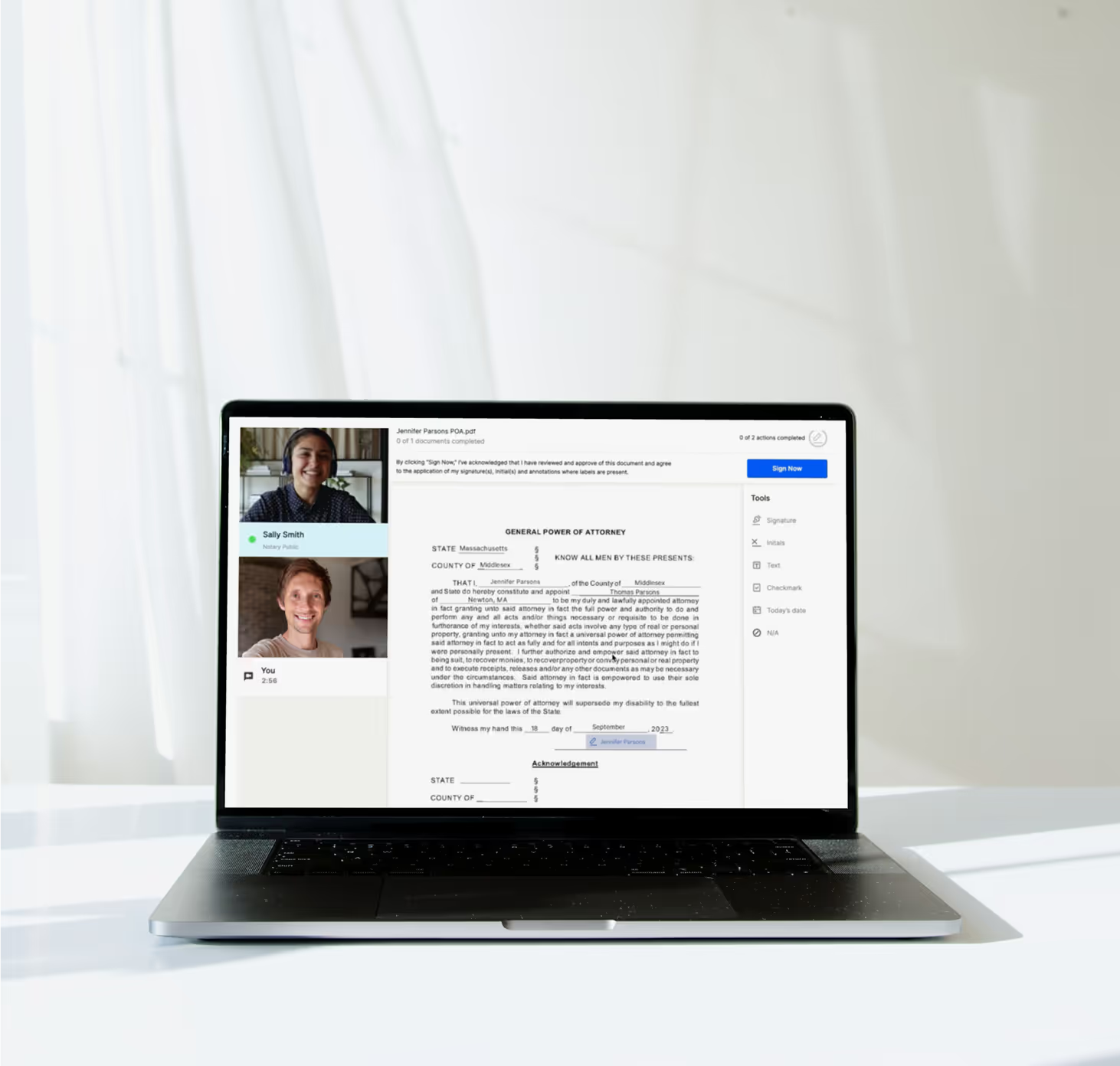
Open laptop on white desk displaying a video call with two people and a document titled 'General Power of Attorney' open on screen.
Real Vermont attorney support and services in-app
Affordably access support from Vermont-based attorneys any time — all online.
WE’RE THE WORLD’S PRENUP EXPERTS
Everything to know about Vermont prenups
First things first: in Vermont, prenups are called “antenuptial agreements.” An antenuptial agreement (or “prenup” as we’d prefer to call them) is a legally enforceable contract between two people who are planning to get married. The agreement becomes legally binding upon the marriage of the couple. A prenup may outline the division of property, alimony, and other financial matters in the event of divorce or death.

In Vermont, prenuptial agreements are governed by legal precedents established through court decisions (this is called case law) rather than specific statutes. This means that past rulings by Vermont courts shape the requirements and enforceability of prenups in the state. Some of the main decisions in Vermont that govern the enforceability of a prenup are Bassler v. Bassler, 593 A.2d 82 (1991), Stalb v. Stalb, 719 A.2d 421 (1998), and Rock v. Rock, 308 A.3d 492 (2023).

Do I need a lawyer for my Vermont prenup?

Vermont doesn’t have a specific law requiring an attorney for a valid prenuptial agreement. However, a recent Vermont Supreme Court case, though unreported, upheld a prenup even when one party didn’t have a lawyer. The Court noted that this person had the opportunity to get a lawyer but chose not to, highlighting that not having an attorney doesn’t automatically invalidate a prenup. Seguin v. Brown, No. 23-AP-115, 2023 WL 7490253, at *3 (Vt. Nov. 13, 2023).

Takeaway? Having a lawyer is not a prerequisite to a valid and enforceable agreement in Vermont. However, a court may consider whether or not you and your partner had the opportunity to consult with an attorney if your prenup is ever challenged.
Aerial view of a small town with colorful autumn trees surrounding historic buildings and churches with steeples.Aerial view of a small town with colorful autumn trees, historic buildings, and church steeples under a partly cloudy sky.Small town with colorful autumn trees, multiple church steeples, and houses nestled among hills under a partly cloudy sky.

Default law on property division in Vermont

What happens to your property if you get a divorce in Vermont without a prenup? Vermont is an equitable distribution state, which means courts aim to divide all marital property fairly, considering factors like the length of the marriage, each spouse’s age, health, income, earning potential, contributions to the marriage (including as a homemaker), and the needs of each party.

This division also takes into account whether one spouse will receive spousal maintenance (i.e., alimony) and the possibility of future inheritances, though only if there’s solid evidence about them. The goal is to achieve an equitable split, not necessarily an equal one, recognizing that a 50/50 division might not always be the fairest outcome.

>>See Vt. Stat. tit. 15 § 751 for the fine print on Vermont property division

Default law on alimony (a.k.a. “maintenance) in Vermont

In Vermont, without a prenup, a court can order one spouse to pay maintenance (also known as spousal support or alimony) to the other ex-spouse during or after a divorce if the spouse seeking support doesn’t have the means to meet their reasonable needs and can’t support themselves through employment. A Vermont court has some discretion in awarding the amount and duration of maintenance but will consider factors such as each spouse’s financial resources, ability to work, the standard of living during the marriage, length of the marriage, age, health, and more.

Vermont also has guidelines that lay out a range of how much a court can award based on the length of the marriage and a percentage of the difference in each spouse’s income. For example, for couples who have been together for under 5 years, alimony may only be awarded between 0 and 16% of the difference in the spouse’s income for up to 1 year or no maintenance at all. (You can see the full guidelines in the Vermont maintenance statute here.)

>>For the fine print on maintenance in Vermont, see Vt. Stat. tit. 15 § 752.

How commingling can destroy your prenup in Vermont

In a 2023 Vermont Supreme Court case, the court ruled that a prenuptial agreement can be voided if the couple’s actions consistently contradict its terms. In this specific case, the couple had a prenup stipulating separate ownership of assets, but over time, they combined their major assets into a single investment account and shared expenses, clearly demonstrating their intent to disregard the agreement. This led the court to declare the prenuptial agreement abandoned.

The court specifically stated that a couple can void their prenup by “commingling [their] marital or non-marital property or by conduct which shows an intent to ignore the agreement and treat non-marital property as marital property.” Rock v. Rock, 308 A.3d 492 (2023) (We go more in-depth on this case below).

Bottom line? Act in accordance with your prenup in Vermont. If you want to keep a bank account separate, make sure you actually keep it separate and don’t mix funds with your spouse.

How to end a marriage in Vermont

To file for divorce in Vermont, at least one spouse must have lived in the state for six months. However, a final divorce decree won’t be granted until one spouse has been a resident for a full year. (Vt. Stat. tit. 15 § 592). In addition, Vermont has various grounds for divorce, including:
  • Adultery
  • Imprisonment
  • Intolerable severity (feeling threatened/in danger)
  • Willful desertion
  • Permanent physical or mental incapacity
  • Living apart for six consecutive months, the court finds that the resumption of marital relations is not reasonably probable.
  • (Vt. Stat. tit. 15 § 551)
The most common grounds for divorce is the last one (it’s the easiest one to file), which requires you and your partner to live separate and apart for six months before filing for divorce.

Vermont case law

In Vermont, prenuptial agreements are shaped by the precedents set in court decisions rather than by specific statutes. This means that understanding Vermont case law is crucial when creating or enforcing a prenup in the state. Let’s explore what Vermont courts have to say about these agreements.
Chevron
Vermont’s foundational case on prenups, shaping Vermont’s view on prenups even today

In Bassler v. Bassler, the Vermont Supreme Court refused to enforce a prenup because it denied the wife any portion of the husband’s property, and she was receiving public assistance at the time of the divorce.

Linda and her daughter moved in with George on his mother Dolores’s estate in 1983. Linda and George eventually got pregnant, and George agreed to marry her but only if she signed a prenup. The prenup heavily favored George and said Linda got nothing. After separating, Linda and her two kids went on public assistance while George remained on the estate. Linda filed for divorce, and George asked the court to enforce the prenup, which basically said Linda gets nothing.

The result? The court ruled that the prenuptial agreement was unenforceable because it left Linda reliant on public assistance, a situation that could have been avoided if the agreement was not in place.

This court also laid out the foundation for what makes a prenup enforceable in Vermont. It said that the enforceability of a prenup is governed by consideration of whether:

  • Each spouse has made fair and reasonable disclosure to the other of his or her financial status
  • Each spouse has entered into the agreement voluntarily and freely
  • The substantive provisions of the agreement dividing the property upon divorce are fair to each spouse.

The court also noted that Vermont public policy will not allow the enforcement of a prenup that is unconscionable (i.e., overly one-sided) at the time it is executed.

Additionally, where, at the time of the divorce, a prenup leaves one spouse a public charge or close to it, the agreement may be unenforceable as against public policy.

Bassler v. Bassler, 593 A.2d 82 (1991).

Chevron
A 2023 Vermont Supreme Court case on how your actions can void a prenup in Vermont

The Vermont Supreme Court, in 2023, decided an important prenuptial agreement case. The court said that if a couple acts against the terms of their prenup, it can be rescinded based on their actions without another written contract in place. The court held that the parties’ actions in this specific case were clear in that they intended to cancel the agreement.

In the case, the 1994 prenup stated that:

  • Each spouse would keep both pre-marital and marital assets separate,
  • If they acquired jointly held assets, they would divide them based on their respective contributions.
  • They would pay living expenses in proportion to their income and separately pay their individual debts;
  • They would file separate tax returns or, if filing jointly, allocate tax funds and liabilities according to their respective incomes.
  • The wife is to be compensated for any work she does for the business entirely through wages.

The parties did not follow any of these provisions. By the time of their divorce, the assets listed in the prenup no longer existed. Instead of maintaining separate property as the prenup dictated, they had consolidated their major nonretirement assets, excluding the marital home and the LLC, into a single investment account held in the husband’s name. This account, however, contained funds from both parties, including the wife’s salary and contributions to the business, as well as proceeds from the sale of their jointly owned motorhome.

Rock v. Rock, 308 A.3d 492 (2023).

Laptop on wooden cabinet displaying a questionnaire completion webpage with checklist items and a beach photo.Laptop on a wooden cabinet displaying a questionnaire webpage with a beach image and checklist.
HOW OUR PRENUP WORKS
Easy, all-in-one solution, completed in a day
1
Fill out your questionnaires
Share your goals and assets in your personal questionnaires.
2
Align on clauses together
Compare answers and align on your prenup terms together.
3
Optional — Review with an attorney
Meet with an attorney to further customize your prenup.
4
Review and notarize your prenup
Review and notarize your prenup online with Proof.
Certified Top Attorneys Standing By
Optional attorney support
at a fraction of the cost
Open laptop on a round wooden table displaying a webpage with profile pictures and names under 'Attorney Representation'.
Ask an attorney any time
(real quote from one of our customers!)
Get legal advice any time by adding on a 20-minute call with an attorney to your prenup for only $49 per partner, per session.
How it works
Smiling woman in orange sweater waving while video chatting on laptop in bright living room.
Optional representation
Attorneys are standing by. Select one of your state’s top attorneys to get an optional full document review for added peace of mind.
Pricing
Person using a laptop displaying a video call interface with a participant named John and a join meeting button.
Online notarization
Skip the drive to the notary. E-sign & notarize your agreement in minutes in your account through our integrated partnership with Proof.
Attorney services
Smiling couple sitting on a brown leather couch, using a laptop together in a cozy living room.Smiling couple sitting on a brown leather couch using a laptop together in a bright living room.Smiling couple sitting on a couch looking at a laptop together.
Want some guidance?
Book a free consultation
Not sure if you want/need an attorney? Book a consultation with a HelloPrenup team member today!
Learn more about how HelloPrenup works and what to expect about the process. We’re thrilled to answer any questions you have and help you get started.
A TRUSTED PRENUP THAT’S AFFORDABLE
We value full 
financial transparency
We encourage every couple to enter their marriage with full financial transparency and we’re starting our relationship with you the same way. Our prenup packages are flexible to adapt to exactly what you and your partner need.

It’s free to start creating and then requires a flat payment of $599 to complete. Along the way, you can add on additional services as needed, any time. Use the calculator to get an estimate. You can also choose to sign now and pay later with:
stat-flag-img arrow

Our online prenup $599 flat fee per couple

Notarization optional add-on
Attorney Q&A optional add-on
Attorney Representation optional add-on
Our attorney representation costs are 40–80% less than other online services i
Your customized total per couple $599

Same-day completion. Taxes included.

Start your prenup for free
A prenup isn’t just about protection.
It’s about going into marriage with a foundation based on transparency and trust.
A prenup is no longer a taboo — it’s a to-do.
Get a state-specific notarized prenup onlinewithout overspending on money or time.
Get a state-specific notarized prenup online and save on money and time.