The leading, comprehensive
Michigan prenup
Did you know Michigan has the most miles of freshwater shoreline than any other state? Did you also know that Michigan’s prenup laws can be super tricky to navigate? Well, we can help you steer the ship on Michigan prenups. 
Forbes LogoShark Tank LogoThe New Yorker Logo
Person typing on a laptop displaying a questionnaire webpage with a prenup checklist.
“Like Turbotax for prenups.”
(real quote from one of our customers!)
We’ll walk you through all of the scenarios you’ll need to consider in Michigan
Two women on rocky terrain high-fiving with a vast desert landscape in the background.
Only $599 for an official, 
Massachusetts-specific prenup
Excellent 4.8
Trustpilot
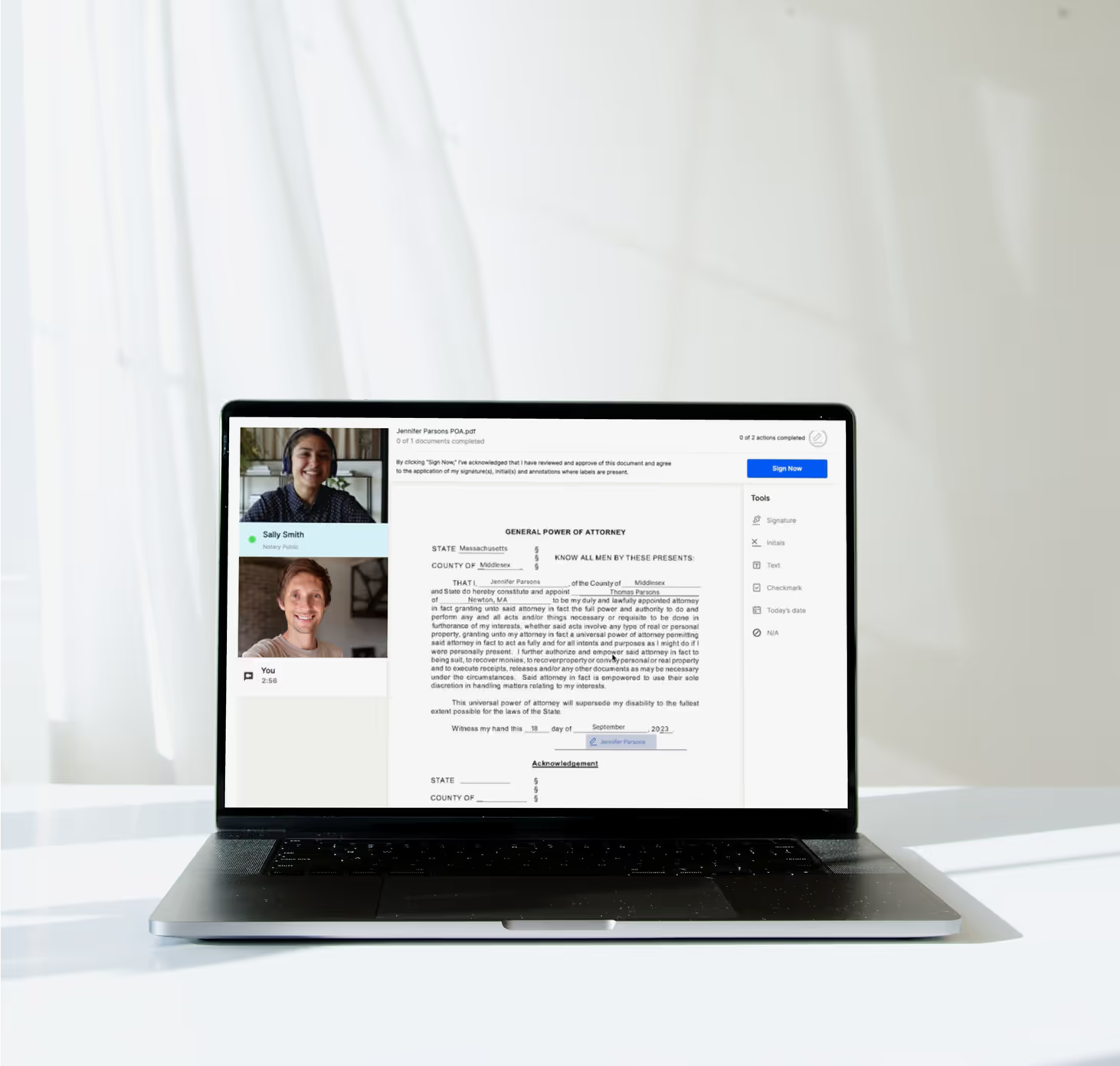
Open laptop on white desk displaying a video call with two people and a document titled 'General Power of Attorney' open on screen.
Real Michigan attorney support and services in-app
Affordably access support from Michigan-based attorneys any time — all online.
WE’RE THE WORLD’S PRENUP EXPERTS
Everything to know about Michigan prenups
The Michigan courts refer to a prenuptial agreement as an “antenuptial agreement” and sometimes also a “prenuptial agreement.” An antenuptial agreement and prenuptial agreement are the same thing: a legal contract drafted between two parties before getting married. A prenup is only valid after the marriage takes place. Michigan’s Antenuptial Agreement statute and case law govern the laws in Michigan pertaining to prenups and outline the rules and requirements for a valid agreement. The terms of a Michigan prenup agreement may include alimony, property division, attorney’s fees, retirement accounts, and more. On the other hand, a prenup in Michigan cannot limit or contract around child support or child custody. Michigan courts have the right to throw out your prenup if they don’t think it’s fair. 

What makes a Michigan prenup enforceable?

Chevron
What to include in a valid Michigan Prenup

For a Michigan prenup to be considered valid, you should consider the following:

  • The contract must be in writing
  • The terms must be fair, equitable, and reasonable
  • The terms must be lawful
  • Must be signed voluntarily by both parties (without being under duress, fraud, or misrepresentation)
  • The contract must be signed at a reasonable amount of time before the wedding
  • Full disclosure of all financial assets and income *Do not skimp on this*
  • It is strongly recommended that both parties be represented by their own attorneys
  • It is strongly recommended that there be witnesses
  • It is strongly recommended that the contract be notarized
Chevron
What to exclude from your Michigan prenup

To make sure that your prenup comports with Michigan law, make sure not to include…

  • Child support or child custody
  • Unfair, inequitable, or unreasonable terms
  • Unconscionable terms
  • Provisions that violate the law or public policy

Keep in mind, if the Michigan courts think your prenup creates an unfair result, they can overturn it and work out their own terms for your divorce.

Man in suit and orange tie sitting at a desk with a laptop, with text reading Michigan Prenuptial Agreements and Hello Prenup logo.

What do the courts consider a fair prenup?

Before 1991, the state of Michigan didn’t even recognize prenups in the context of divorce! The 1991 Rinvelt case changed all of that. Previous courts had stated that prenups in anticipation of divorce were against public policy. The Rinvelt court disagreed and declared that prenups are great for parties to foster a healthy relationship.
The Rinvelt case set out the following standards for which a Michigan court will look at when determining if a prenup is fair:
  • The agreement was not made through fraud, duress, mistake, or misrepresentation
  • Full disclosure was made to both parties before the agreement was signed
  • The agreement was not unconscionable when executed
  • Since the signing of the prenup, the facts and circumstances have not changed in such a way that enforcing the prenup would be unfair for either party
Rinvelt v. Rinvelt, 190 Mich.App. 372 (1991). 

Statutes and terms to understand in Michigan

*Before we go into terminology, we highly suggest reviewing our “Prenup Encyclopedia” that breaks down general Prenuptial Agreement legal terminology and phrases to know.
Chevron
Michigan Antenuptial Agreement Statute and Case Law

If you would like to get a prenup in Michigan, you must comply with the following:

  • The contract must be in writing
  • The terms must be fair, equitable, and reasonable
  • The terms must be lawful
  • Must be signed voluntarily by both parties (without being under duress, fraud, or misrepresentation)
  • The contract must be signed at a reasonable amount of time before the wedding
  • Full disclosure of all financial assets and income *Do not skimp on this*
  • It is strongly recommended that both parties be represented by their own attorneys
  • It is strongly recommended that there be witnesses
  • It is strongly recommended that the contract be notarized
  • Do not include clauses about child custody or child support, that is for the court to decide

Michigan Compiled Laws (MCL) Section 557.28 is the statute governing prenups in Michigan. You can see the statute’s fine print here. Most of Michigan’s prenuptial standards are based on case law.

Chevron
A FAIR play by the Michigan court

What do Michigan judges deem as a fair prenup under Michigan law? Well, for starters, Michigan courts have a lot of wiggle room to decide whether a prenup is fair or not. If the court thinks it’s unfair in any way, then the court can and will declare the prenup invalid. A landmark Michigan prenuptial case from 2005 speaks volumes about prenup fairness. The case goes as follows.

Husband and Wife were married in 1975. Husband was a newly graduated lawyer and Wife was an engineer. At the time of marriage, they had a combined net worth of $20,000. About two months before their wedding day, they executed a prenup. The prenup stated that both parties would keep their own separate property and Husband would get to keep the home they lived in throughout the marriage. Throughout the marriage, they kept their finances separate, with separate bank accounts and even purchasing property under their own separate names.

All good things come to an end, and for this Detroit couple, it was in the year 2000. Wife filed for divorce in 2000 after a 25-year marriage. At the time of divorce, Wife and Husband were each making an identical $1,000,000 per year. In the divorce proceedings, Wife asked the court to declare the prenup invalid because there was a change in circumstances making the prenup unfair. Wife’s argument stems from their combined net worth going from $20,000 to more than $2,000,000. Husband disagreed and asked the court to deem the prenup valid. Husband counter-argued that they kept separate bank accounts and purchased property separately all these years. He also argued that Wife never saved any money, and that’s why she’s asking for the prenup to be wiped.

The million-dollar question (literally): what did the court think? Drum roll… the court held this prenup to be fair! The court reasoned that just because their assets grew substantially does not mean that the circumstances changed so much that it deemed the prenup invalid. In other words, just because the Husband had a lot more money at the time of the divorce and the prenup now benefits him does not make the prenup unfair. (Reed v. Reed, 265 Mich.App. 131 (2005))

Chevron
Allard v Allard, 318 Mich App 583; 899 NW2d 420, 596 (2017)

Along with unsuccessfully challenging the validity of the couple’s prenuptial agreement, former wife sought equitable distribution of the parties’ assets pursuant to the court’s statutory authority (i.e. distribution as if there were no prenup). However, the trial court declared that it was bound by the antenuptial agreement. The appellate court disagreed and reversed. In reaching its conclusion, the court attempted to reconcile the two “bedrock principles”: “first, that the fundamental right to contract must be protected by allowing parties to contract freely and by enforcing contractual agreements; second, that courts sitting in equity must be free to afford whatever relief is necessary to see done that which, in good conscience, ought to be done.” While the laws of divorce are statutory in nature, the division of property must be equitable. Former husband argued that parties can divest the courts of its statutory authority to effectuate an equitable settlement by way of an antenuptial agreement. See MCL 557.28 (“A contract relating to property made between persons in contemplation of marriage shall remain in full force after marriage takes place.”). However, parties cannot enter into contracts which are contrary to public policy. See Maids Int’l, Inc. v. Saunders, Inc., 224 Mich.App. 508, 511, 569 N.W.2d 857 (1997) (“contracts founded on acts prohibited by a statute, or contracts in violation of public policy, are void.”).

The court reasoned that the Legislature clearly demonstrated that it intends circuit courts, when ordering property division in a divorce matter, to have equitable discretion to “invade separate assets” if doing so is necessary to achieve equity (i.e. make things fair). See MCL 552.12 See footnote 1, below; MCL 552.23(1) See footnote 2, below; MCL 552.401 See footnote 3, below. This right is held by the circuit courts, not the parties themselves. Therefore, the right cannot be waived by the parties to an antenuptial agreement. “Put differently, the parties to a divorce cannot, through antenuptial agreement, compel a court of equity to order a property settlement that is inequitable. Although parties have a fundamental right to contract as they see fit, they have no right to do so in direct contravention of this state’s laws and public policy” Id. at 601. Therefore, the court declared that parties may not waive the court’s equitable discretion (i.e. power to divide things fairly) via antenuptial agreements. Read the entire case here.

Couple dressed in wedding attire standing on a rocky cliff overlooking a winding river through a canyon at sunset.Couple in wedding attire standing on a rock ledge overlooking a canyon with a river below at sunset.Bride and groom in wedding attire standing on a rocky cliff overlooking a canyon with a river below at sunset.

Divorce statute and how to end a marriage in Michigan

“Divorce statute” is the official term for Divorce in Michigan

A divorce occurs when two people, who have been legally married, begin the court process to end the marriage. Some states refer to divorce as “dissolution of marriage,” which also refers to the general process of a divorce. Michigan refers to the ending of a marriage as the more commonly known term “divorce.”  
Chevron
How to end a marriage in Michigan

There are three ways that a couple can legally end a marriage in Michigan: separate maintenance, annulment, and divorce. Only one party needs to begin the process of ending a marriage (but don’t get us wrong, it takes two to make it work!) If one party wants to divorce the other party, it is within their sole right to do so, and the other non-participating party does not have to agree in order to begin the process. If a non-participating spouse does not partake in the proceedings, a default judgment will be entered and force the divorce to proceed.

Chevron
Residency requirement

Each state has residency requirements that must be fulfilled before you can divorce in that state. In Michigan, these are the residency requirements:

  • One spouse has resided in Michigan for 180 days immediately before filing the divorce.
  • One spouse has resided in the county where the divorce is filed for at least 10 days immediately before the filing.
Chevron
No-Fault Divorce

Michigan is a “no-fault” divorce state – meaning either party can file for a divorce without having to prove that the other party did something “wrong” to justify the divorce. Michigan is a pure no-fault state, so you will need to claim that the marriage is irretrievably broken. In other words, your divorce is beyond repair, and it must end in divorce.

>>For the entire fine print review Michigan Compiled Laws Section 552.6

Separate property in Michigan

Separate property is the property you get to keep in the divorce settlement. In Michigan, separate property is obtained or earned before the marriage. On the other hand, marital property is acquired or earned during the marriage. Marital property is what will be divided up in the divorce. Be careful though because there are exceptions to these standards: 
  • If one spouse receives an inheritance during the marriage, it is deemed separate property. 
  • If one spouse acquired a property before the marriage, but both spouses put in work on the property to improve it, it may become marital property.
  • If separate property becomes frequently used for marital purposes, it may become marital property subject to distribution. For example, if an inheritance is deposited into the shared bank account.
  • f one spouse receives proceeds in a personal injury lawsuit for pain and suffering, it is considered separate property.
Chevron
What about worker’s compensation?

A divorce in 2010 helped Michigan courts decide if, and to what extent, workers’ compensation benefits received during a marriage is separate or marital property. Remember, marital property is subject to distribution in the divorce. Separate property is what you keep.

The facts of the case are as follows. A Michigan couple divorced. Wife wanted Husband’s workers’ compensation to be considered marital property so it would be distributed in the divorce settlement. Husband wanted the workers’ compensation to be considered separate property so he could keep it.

What did the court think? The court said that workers’ compensation is marital property (a.k.a. it would get split up in the divorce) if it compensated for wages lost. If the workers’ compensation was for pain and suffering, it would be considered separate property and, therefore, not split up. (Cunningham v. Cunningham, 289 Mich.App. 195 (2010)).

Alimony in Michigan

In Michigan, courts consider the primary purpose of alimony to be balancing the income of the parties’ needs so that neither party will be unequally disadvantaged. Michigan courts want to create an outcome that is just and reasonable. The factors that they will consider determining reasonableness are the following:
  • The past relations and conduct of the spouses
  • The length of the marriage
  • The abilities of the spouses to work
  • The type of property awarded to the spouses in the divorce proceeding
  • The spouses’ ages (in retirement already? Too old to find work?)
  • The abilities of the spouses to pay alimony
  • The present situation of the spouses
  • The needs of the spouses 
  • The spouses’ health 
  • The spouses’ prior standard of living
  • The contributions of the spouses to the joint estate
  • A spouse’s fault in causing the divorce
  • The effect of cohabitation on a spouse’s financial status, and
  • General equity principles (anything else the court may consider reasonable)
To calculate the amount of alimony awarded, Michigan courts typically examine age, education, length of marriage, and income of the parties.
Types of alimony
Michigan offers two different types of alimony: rehabilitative and permanent alimony. Rehabilitative alimony is temporary in nature and gives a spouse the ability to return to the workforce. Permanent alimony lasts long-term.
Max Emmer Profile
Max Emmer, Esq.
Max Emmer is a Michigan attorney who believes that prenups can improve marriages through good communication and financial transparency. He understands both the legal and deeply emotional aspects of prenuptial agreements and aims to help his clients reach a resolution in the most helpful and efficient way possible. Consider reaching out to Max with any Michigan prenup questions, concerns, and if you would like advice or representation.


EmmerLawPLC.com
Max@EmmerLawPLC.com
social iconsocial icon
Laptop on wooden cabinet displaying a questionnaire completion webpage with checklist items and a beach photo.Laptop on a wooden cabinet displaying a questionnaire webpage with a beach image and checklist.
HOW OUR PRENUP WORKS
Easy, all-in-one solution, completed in a day
1
Fill out your questionnaires
Share your goals and assets in your personal questionnaires.
2
Align on clauses together
Compare answers and align on your prenup terms together.
3
Optional — Review with an attorney
Meet with an attorney to further customize your prenup.
4
Review and notarize your prenup
Review and notarize your prenup online with Proof.
Certified Top Attorneys Standing By
Optional attorney support
at a fraction of the cost
Open laptop on a round wooden table displaying a webpage with profile pictures and names under 'Attorney Representation'.
Ask an attorney any time
(real quote from one of our customers!)
Get legal advice any time by adding on a 20-minute call with an attorney to your prenup for only $49 per partner, per session.
How it works
Smiling woman in orange sweater waving while video chatting on laptop in bright living room.
Optional representation
Attorneys are standing by. Select one of your state’s top attorneys to get an optional full document review for added peace of mind.
Pricing
Person using a laptop displaying a video call interface with a participant named John and a join meeting button.
Online notarization
Skip the drive to the notary. E-sign & notarize your agreement in minutes in your account through our integrated partnership with Proof.
Attorney services
Smiling couple sitting on a brown leather couch, using a laptop together in a cozy living room.Smiling couple sitting on a brown leather couch using a laptop together in a bright living room.Smiling couple sitting on a couch looking at a laptop together.
Want some guidance?
Book a free consultation
Not sure if you want/need an attorney? Book a consultation with a HelloPrenup team member today!
Learn more about how HelloPrenup works and what to expect about the process. We’re thrilled to answer any questions you have and help you get started.
A TRUSTED PRENUP THAT’S AFFORDABLE
We value full 
financial transparency
We encourage every couple to enter their marriage with full financial transparency and we’re starting our relationship with you the same way. Our prenup packages are flexible to adapt to exactly what you and your partner need.

It’s free to start creating and then requires a flat payment of $599 to complete. Along the way, you can add on additional services as needed, any time. Use the calculator to get an estimate. You can also choose to sign now and pay later with:
stat-flag-img arrow

Our online prenup $599 flat fee per couple

Notarization optional add-on
Attorney Q&A optional add-on
Attorney Representation optional add-on
Our attorney representation costs are 40–80% less than other online services i
Your customized total per couple $599

Same-day completion. Taxes included.

Start your prenup for free
A prenup isn’t just about protection.
It’s about going into marriage with a foundation based on transparency and trust.
A prenup is no longer a taboo — it’s a to-do.
Get a state-specific notarized prenup onlinewithout overspending on money or time.
Get a state-specific notarized prenup online and save on money and time.